When responding to speech we don’t like, a useful guideline is to ask ourselves, “Am I disagreeing, or am I retaliating? Am I trying to persuade, or am I trying to silence?” If retaliation or silencing is the goal, remember that such techniques will ultimately be used not just on “bad” speech, but on “good” speech, as well. And when people refrain from speaking because they fear personal retribution from corporations, the media, academia, or an unruly Twitter mob, the value of their speech is lost—lost in the same way it would be if the government threatened them with punishment.
Tuesday, August 20, 2019
New piece in Quillette: Free speech is about more than the First Amendment
I'm pleased to appear in Quillette this week on a topic that I had been wanting to write about for a long time -- namely, the importance of recognizing free speech as a cultural value rather than simply a restraint on the government. The piece has received a decent amount of attention. From the conclusion:
Read the whole thing there.
Thursday, May 23, 2019
The College Board’s “adversity score” perpetuates the myth of SAT bias
[I originally wrote this for NR, but I'm reposting here because this perspective has not received enough attention.]
[Update: I wrote another piece addressing similar misinformation about the SAT.]
[Update: I wrote another piece addressing similar misinformation about the SAT.]
A common defense of affirmative action in college admissions is that it simply adjusts for difficult childhood circumstances. Under this theory, students from underrepresented groups score below their true ability level on the SAT due to poverty or discrimination or a lack of fancy test prep, but they will thrive once brought to an enriching university environment. If true, affirmative action would not involve any lowering of admission standards, but rather a fairer appraisal of each applicant’s abilities.
It’s not true. Researchers have known for decades that SAT scores predict college performance for poor and minority students about as well as they do for everyone else. To the extent there is a difference, the SAT actually over-predicts their performance. Therefore, if the goal is to find the students who will be most academically successful, colleges should not bump up applicants’ SAT scores on the basis of poverty or race.
That’s one reason why the College Board’s new “adversity score” is so troubling. By providing schools with a secret quantification of each applicant’s childhood environment, the College Board furthers the myth that the SAT is predictively biased along socioeconomic lines. According to the New York Times:
Admissions officers have also tried for years to find ways to gauge the hardships that students have had to overcome, and to predict which students will do well in college despite lower test scores. The new adversity score is meant to be one such gauge.
If so, we already know it doesn’t work. The College Board’s own data (see page 42) show that test scores and high school grades predict college performance about equally across all adversity levels. An exception is for students at the highest levels of adversity where, once again, their college GPA is slightly below expectations, not above.
In reality, there is no merit-based case for affirmative action in college admissions. Proponents should acknowledge that their chief interest is not merit, but social justice. “Diversity is so important to our schools and to broader society that lowering standards is a worthy price to pay,” they should declare. That would be a reminder that affirmative action – like all hotly-debated issues –involves inherent trade-offs, and it’s up to the public to decide how to weigh them.

Sunday, May 5, 2019
Sign the petition for Dr. Noah Carl
Free speech is about more than just the First Amendment's limitation on government power. It's a principle that should underlie all political discourse. When institutions that promote themselves as open platforms banish those with whom they disagree, it has the same kind of chilling effect as government censorship.
Academic freedom is an especially important subset of free speech. If universities place limitations on what academics can study, whole areas of knowledge could be closed off. That's why I signed the petition for Dr. Noah Carl, and it's why you should, too.
Remember, when a mob demands censorship, it's easy to hope that capitulating "just this one time" will make the problem go away. It won't. It will only lead to more severe demands for censorship in the future.
Monday, March 4, 2019
Video of event with Michelle Malkin
It went well. The transcript and all videos can be found here. I've embedded my section below. (If you read the transcript or watch the unedited video from Facebook, you'll note a few strange interjections. We were having a problem with the computer screen flickering.)
Tuesday, February 26, 2019
Panel event with Michelle Malkin
On Friday, March 1, at 4:00 pm at the National Press Club, I'll be appearing on a panel with Michelle Malkin. We''ll be discussing high-skill immigration, and the starting point will be my new report discussed in the previous post. Admission is free, and there will be food provided, so please come.
WASHINGTON, D.C. (February 26, 2019) – The Center for Immigration Studies will host a panel discussion and reception Friday, March 1 focusing on the impact of immigration on skilled workers and the value of a foreign vs. domestic diploma. The starting point for conversation will be the recent report by independent policy analyst Jason Richwine which compared the skill levels of foreign-educated immigrants and native-born Americans.
REPORT: Foreign-Educated Immigrants Are Less Skilled Than U.S. Degree Holders
WHAT: Panel discussion on the value of foreign college degrees and the reality behind "high-skill" immigration
WHEN: Friday, March 1, 2019 at 4:00 p.m.
WHERE: National Press Club, Murrow Room, 529 14th St NW, Washington, D.C.
STREAM: Facebook Live
WHO:
MICHELLE MALKIN
Michelle Malkin is a nationally syndicated commentator and co-author of the 2015 book "Sold Out", which explores the effects of current immigration policies on American skilled workers. In the book, which she co-authored with CIS Fellow John Miano, she writes, "There is nothing special about the hundreds of thousands of H-1B visa holders flooding our workforce. Most are sponsored by companies that specialize in outsourcing of U.S. jobs."
JASON RICHWINE
Jason Richwine is an independent public policy analyst based in Washington D.C. and the author of the recent report, "Foreign-Educated Immigrants Are Less Skilled Than U.S. Degree Holders." In it, Richwine demonstrates that supposedly "high-skill" foreign-educated immigrants drastically under-perform native-born Americans with comparable degrees in various standardized exams.
Monday, February 25, 2019
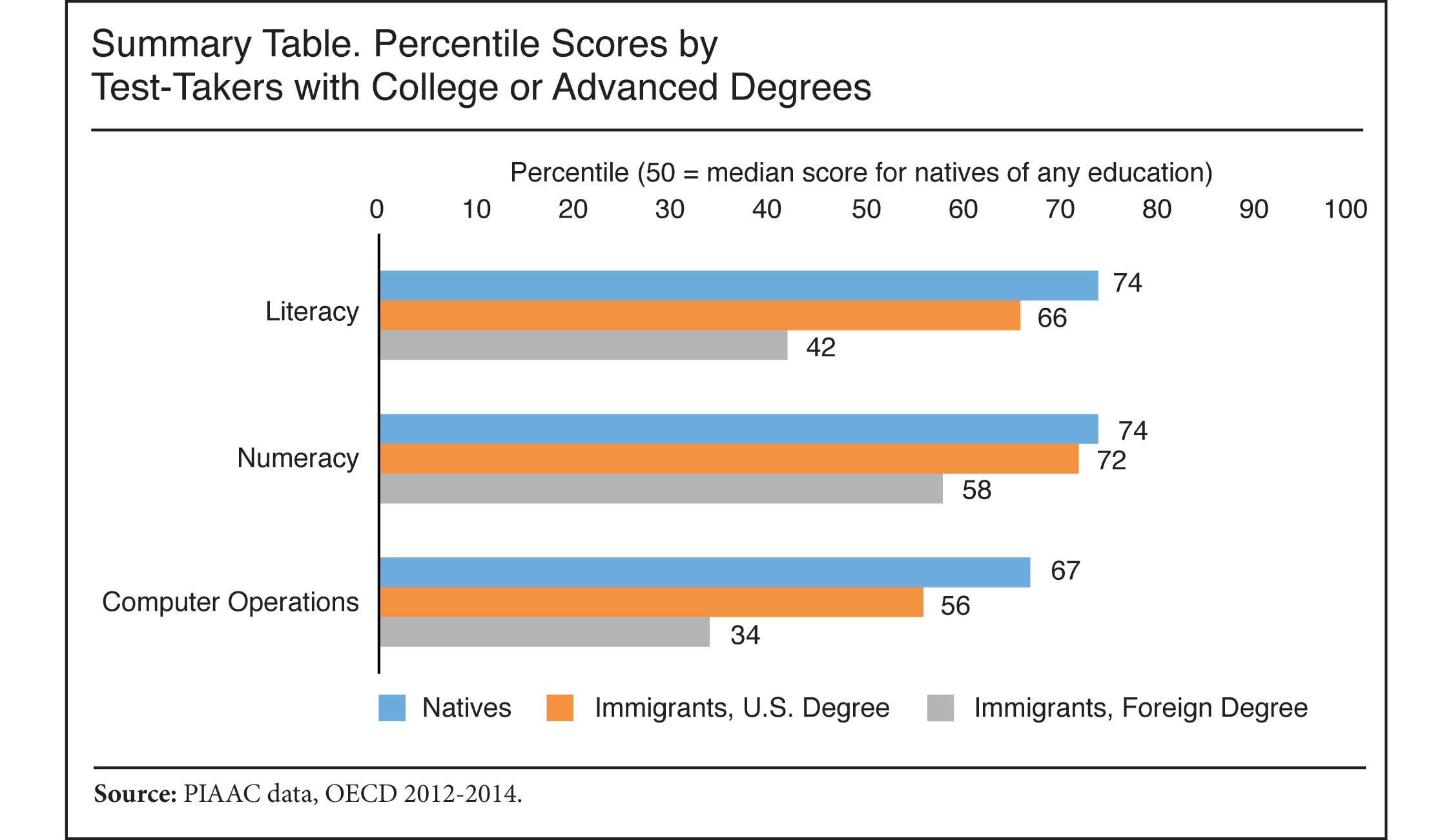
Highly-Educated Immigration ≠ Highly-Skilled Immigration
I have a new report out this week with a self-explanatory title, "Foreign-Educated Immigrants Are Less Skilled Than U.S. Degree Holders." Here's the summary chart:
![]() |
And here's the conclusion:
Although skilled immigration may be desirable, policy-makers must be cautious in using foreign degrees as proof of those skills. This report has shown that immigrants with foreign degrees perform substantially worse than U.S. degree holders on tests of literacy, numeracy, and computer operations. In some cases, the gaps are so large that immigrants with foreign college degrees have skills that resemble those of natives who have only a high school diploma. Although poor English clearly plays a role in the disparity — and a command of English is essential for success in most high-skill occupations in the United States — the disparity persists even among immigrants who have had at least five years to learn English after arriving.
In Congress, some proposed immigration reforms acknowledge the greater value of U.S. degrees. For example, the RAISE Act would establish a points system for high-skill immigrants that prioritizes U.S. degrees over foreign degrees. It would also go beyond educational credentials by giving extra points for English fluency, STEM specialties, and pre-arranged employment. Ultimately, policy-makers should consider making skill selection even more direct. Universities, the foreign service, and the military have been using standardized testing for decades to evaluate applicants. For example, people who want to do advanced study in important subjects such as biology, chemistry, and physics need to take the Graduate Record Exam (GRE) to demonstrate their knowledge and preparation. Perhaps Congress could integrate similar tests into a truly high-skill immigration system.Please read the whole thing.
Thursday, February 21, 2019
The threat to English
My first piece for American Greatness is out today. It deals with the issue of language assimilation. A sample:
For decades, immigration enthusiasts have offered conflicting assurances to skeptics who perceive a lack of assimilation among newcomers. Multiculturalism is a great gift to the United States, so why worry? Also, assimilation is proceeding apace, so, again, why worry? The former assurance is generally directed at liberals, and the latter is directed at conservatives, but the underlying point is the same—nothing to see here, just move along.
Pundits repeated the same assurances last month after Tom Brokaw remarked on how “Hispanics should work harder at assimilation,” and that “they ought not to be just codified in their communities but make sure that all their kids are learning to speak English.” Despite the furor and his subsequent apology, Brokaw is right to be concerned. When it comes to language assimilation, neither of the standard assurances is convincing.Please read the whole thing.
Subscribe to:
Posts (Atom)