How Is Trump 47 Doing on Immigration? ft. Jason Richwine by Patrick Casey
Restoring Order - EP 319
Read on Substack[originally posted at National Review]
The debate over vaccine mandates has fuzzy boundaries. One can support mandating vaccinations for certain populations at risk of certain diseases without automatically supporting all such mandates. When it comes to Covid-19, we can argue the marginal cases, such as workers at hospitals and nursing homes. However, there is little justification for broad-based mandates that treat all unvaccinated people as second-class citizens. The unvaccinated should not be denied livelihoods, barred from public accommodations, forced to mask when others aren’t, or otherwise banned from normal participation in society.
Unfortunately, public health officials have increasingly conflated opposition to mandated Covid vaccination with opposition to voluntary Covid vaccination. If the vaccines are so safe and effective, they reason, what could be wrong with mandating them for everyone?
A lot. People experience a genuine welfare loss when forced to do something against their will. In the case of the Covid vaccines, there are some people whose reluctance stems from deeply-held convictions about bodily integrity and autonomy. Giving them a no-jab-no-job ultimatum causes them psychological distress. It sows resentment, distrust, and alienation. It stokes fears of a slippery slope. It causes real harm.
Supporters claim that vaccine mandates overcome that harm by providing major benefits for both individual holdouts and for the broader society. For some vaccines in some situations, this may be true. But are the benefits of Covid vaccination really compelling enough to justify widespread coercion?
Let’s consider individuals first. The argument made by mandate proponents goes like this: Although we generally shouldn’t micromanage people’s health choices, recipients experience such a tremendous benefit from the Covid vaccine that a mandate is justified for individuals’ own good. This argument fails because it applies to only a small proportion of the people who will actually be coerced. Take the elderly. They are by far the most vulnerable group, and if anyone should be forced to get vaccinated for their own good, it’s them. Well, nearly all Americans age 65+ have had at least one dose of the vaccine already, so they cannot be the primary targets of any mandate.
Among non-elderly adults, it appears that about one quarter have not had any shots, but a large proportion of those holdouts are not in major risk groups. For one thing, some holdouts were previously infected with Covid and therefore already have strong immunity. We don’t know what that proportion is exactly, but the CDC estimates that about half of non-elderly adults (not specifically vaccine holdouts) have already been infected.
Furthermore, another subset of holdouts are young, healthy individuals at little risk of a severe case. It may still be a good idea for fit people under 30 to get vaccinated, but their refusal is not exactly an act of self-immolation. In short, the number of holdouts who are in dire need of the vaccine is small, and a mandate will force people at much less risk to bear the brunt of the coercion.
The second argument advanced by mandate proponents is that the population as a whole benefits greatly from mass Covid vaccination even if the individual benefit is small. When the vaccines were first rolled out, there was hope that they could produce the sterilizing immunity needed to block Covid transmission. But now we know they do not. Even high rates of vaccination cannot stop waves of Covid infections from washing over countries on a largely seasonal basis. Israel was one of the first countries to experience a post-vaccination wave, and other countries have followed suit. In the U.S., high-vaccination northern states thought they might be immune to the misleadingly-named “pandemic of the unvaccinated” in the south, but now their winter wave is arriving right on schedule, causing some of their worst infection rates since Covid began. “Herd immunity may well be impossible even if every single American gets a shot,” The Atlantic recently acknowledged.
Although mandates will not stop the spread, proponents say they will still preserve hospital capacity by reducing severe cases. But early fears that Covid patients would lay dying outside of overflowing ERs never came to pass, even before vaccines and antibody treatments were developed to make it even less likely. In addition, we have already seen that most vaccine holdouts are not in the high-risk groups that produce the bulk of severe cases.
Since the case for a broad-based Covid vaccine mandate is so weak, why do the calls for it persist? The illusion of control has biased the thinking of public health officials since the beginning of the pandemic. These officials are searching for something -- anything – to be the next button to press or lever to pull to control the virus. We might admire their quixotic project, except that all those buttons and levers have caused severe social disruptions. Their coercive mandates are yet another escalation.
[originally posted at National Review]
On Thursday President Biden unveiled yet another plan to
“beat the pandemic,” following up on his campaign pledge to “shut down the
virus.” It’s time to retire this eliminationist thinking. Over the last several
months, the Covid endgame has become increasingly clear: The virus gradually reaches
an endemic state in which most of us are exposed. That’s it. No intervention –
not lockdown, not masking, not “test and trace,” and not
even the vaccine – has been able to stop Covid’s long march.
Whatever influence the interventions may have on viral spread, it is clearly not enough to prevent major waves of infection from washing over the country, region by region, on a largely seasonal basis. We have 18 months’ worth of proof. That’s why I’m uninterested in debating the quality of that Bangladeshi mask study, or poring over infection trends in states with different indoor capacity rules, or arguing whether self-quarantines should be 10 days or 14 days. Why fight over interventions that are marginal at best? They do not change Covid’s basic pattern, which is a series of seasonal waves that will continue until infection has become sufficiently widespread.
So although we have no choice about the endpoint, we do have a choice about how we get there. We can keep on masking and distancing and quarantining and tut-tutting at people who congregate in large groups, or we can return to normal life as the virus completes its pandemic phase. I vote for normal life.
Accepting the inevitable is difficult for many people, perhaps because Covid has earned such a frightful reputation. But pharmaceuticals have rendered the virus much less dangerous than it was in 2020. Vaccines taken prior to infection prevent most severe cases, and infusions of monoclonal antibodies, received soon after infection, appear to be quite effective as well.
Even some people who understand the low risk associated with a typical Covid case are still reluctant to accept that their own infection is forthcoming. The restrictions themselves deserve some blame here. When a mere positive test requires quarantine and awkward calls to friends and colleagues, it’s understandable that people will take extraordinary measures to avoid it. In that sense, the restrictions are self-reinforcing. Infection is even seen as shameful in some circles, as if it is some kind of personal failing. It’s time to put that all behind us.
The public health establishment does not agree, of course. They have volunteered no specific endpoint for the restrictions, and it’s fair to assume that none is imminent. “If endemicity is the future, then masks, distancing, and other precautions merely delay exposure to the virus—and to what end?” Ed Yong asked in a piece for the Atlantic last month. The answer, the public-health advocates told him, is “to buy time.”
That answer is not persuasive. First of all, how much time is actually available to purchase? As noted above, no intervention has prevented major surges from coming and going at seasonally predictable points in various parts of the country. At best these interventions may have shortened waves, but they did not prevent them. That’s why the most plausible reason to buy time – to prevent hospital overruns – is still unconvincing. Hospitals have been stressed for sure, but the early fear that untreated patients would be dying outside of overflowing ERs never came to pass. With the pharmaceutical treatments available now, it’s hard to believe it ever will.
Other reasons given to Yong for buying time are even less convincing. One is “to keep schools open,” but it is the restrictions themselves that threaten to close schools. Here again the mitigation strategies seem self-reinforcing: We have to quarantine students and close schools at the first sign of an outbreak, because otherwise infections might spread, and then we’d have to... quarantine students and close schools. Once we acknowledge that infection is inevitable, schools are in fact one of the most obvious places to restore normal operations. If we cannot accept that the lowest-risk demographic group (students) will be exposed to the virus, then we are not ready to accept reality at all.
Other justifications for buying time include studying breakthrough infections, further encouraging the vaccine stragglers, and giving hospital workers a break. These are useful goals, but few people outside of public health will believe they are of such importance that they justify preventing a return to normal life. This is one reason that elected leaders should never transfer decision-making authority to public-health advocates. Such advocates have important contributions to make, but they cannot be expected to balance competing interests in the same way that the people’s representatives do.
The public health establishment will always be inclined to ask for more time for its own priorities. Sometimes – like now -- we have to say no. If we are not able to acknowledge the inevitable and recover our freedoms in this moment, I fear we never will.
For a brief period in the early 1990s, I was interested in VH-1’s weekly ranking of music videos. One video that hovered near the top of the charts at that time was Meat Loaf’s “Rock and Roll Dreams Come Through.” It initially caught my eye for its high production quality -- including an early appearance by Angelina Jolie! -- but the song itself grew on me. It was an extravagant paean to rock and roll with several memorable lines, including, “You’re never alone ‘cause you can put on the ‘phones and let the drummer tell your heart what to do.”
The song was a single from Bat Out of Hell II, which became one of the first albums I would ever buy. The whole thing was amazing. And it turned out that the original Bat Out of Hell was even more amazing -- long and complex melodies, elaborate arrangements, over-the-top lyrics, Meat Loaf’s powerful voice -- it was rock opera at its finest.

In the pre-Internet era, it wasn’t easy to learn the stories behind these albums. I remember being confused by the lengthy time gap between Bat I (1977) and Bat II (1993). As I bought more Meat Loaf albums from the 1980s, it became obvious to me that the quality was largely dictated by whether the songs were written by a guy named Jim Steinman. Both Bats had “Songs by Jim Steinman” featured prominently on the covers, and 1981’s Dead Ringer was also written entirely by Steinman. But other Meat Loaf albums featured only a couple of Steinman songs, and sometimes none at all. To be frank, most of Meat Loaf’s non-Steinman songs sucked. They didn’t even sound like Meat Loaf songs. Why did he bother singing without Steinman?
I learned later about the falling out that the two had. Accounts differ, but the basic story is that they were unprepared for the success of Bat I. Meat Loaf in particular did not handle it well. He strained his voice with excessive touring, abused drugs and alcohol, and became an all-around wreck. When it came time to record Renegade Angel, the new album Steinman had written for him, Meat Loaf was unable to do it. Some combination of burnout, drugs, and anxiety had affected his voice.
At the same time, Steinman felt slighted by the attention lavished on the guy who sang his songs. These were his songs, not Meat Loaf’s. In fact, in Steinman’s view, he essentially created the whole Meat Loaf persona that audiences saw on stage. He thought the album should have been credited to “Meat Loaf and Steinman,” or something to that effect, but instead he had to settle for “Songs by....”
Steinman decided to stop waiting for Meat Loaf to recover his voice. He completed the songs himself and released the album under his own name, with the new title Bad For Good. Steinman’s voice was decent, but it was unsuited to the bombastic songs that he wrote. He lacked the power and the range to pull them off. In fact, despite Steinman’s top billing, the lead vocals on the album were often handled by Rory Dodd, Steinman’s longtime demo and backup vocalist who could hit the high notes but still lacked Meat Loaf’s power.
Despite the vocal problems, Bad for Good is proof of Steinman’s independent genius. In essence, he made a Meat Loaf album without Meat Loaf. Everything is in the same style as the Bat albums, from the cover art to the arrangements. Even the vocal inflections we hear from Steinman/Dodd evoke Meat Loaf. The only thing missing was the quality of Meat Loaf’s actual voice. No offense intended against Meat Loaf here, but it’s obvious that Steinman was the main creative force in their partnership.
That became more evident with their diverging careers in the 1980s. While Meat Loaf recorded some forgettable albums with other writers, Steinman kept penning hits -- Bonnie Tyler’s “Total Eclipse Of The Heart,” Air Supply’s “Making Love Out Of Nothing At All,” Barry Manilow’s “Read ‘Em And Weep,” and Celine Dion’s “It’s All Coming Back To Me Now.” The first two songs on that list were simultaneously Billboard’s #1 and #2 songs, respectively, for four weeks in 1983. Rolling Stone called it “Steinman’s total eclipse of the charts.”
Steinman’s success with singles is all the more remarkable given his penchant for long, operatic songs. Most of them had to be cut down for radio play, and it didn’t always work. For example, one of my favorite Steinman compositions is Bonnie Tyler’s “Loving You’s A Dirty Job,” but it’s not the kind of song that can be fully appreciated on a first listen. In fact, it feels like two different songs mashed together, and it takes several hearings to get a feel for what Steinman was going for. I can see how it didn’t play well on the radio.
When Steinman reunited with Meat Loaf for Bat II, he wrote four new songs, led by the megahit “I’d Do Anything For Love.” Meat Loaf also performed older Steinman material for the album, including “Rock and Roll Dreams Come Through,” which first appeared on Steinman’s own Bad for Good. It seemed fitting that Meat Loaf could finally sing these words:
Think of how we'd lay down together
We'd be listening to the radio so loud and so strong
Every golden nugget coming like a gift of the gods
Someone must have blessed us when he gave us those songs
Meat Loaf was indeed blessed, as the album rejuvenated his career. But he and Steinman parted ways again afterward. My sense is that they were simply at different stages of their careers. Steinman was at the end of his creative peak, and he wanted to use some of his material in musical theater and other miscellaneous projects. Meanwhile, Meat Loaf’s voice was as sonorous as ever, and he was eager to seize on his newfound popularity. When he quickly followed Bat II with Welcome to the Neighborhood, I was disappointed to see only two Steinman songs, neither of which was a new composition.
I drifted away from Meat Loaf after that, but I’ve periodically delved deeper into Steinman’s oeuvre. There is actually a lot more to appreciate than just the Bat albums and the big hits. For one thing, there’s 1981’s Dead Ringer, a set of songs that Steinman wrote for Meat Loaf just before they first parted ways. Steinman’s involvement in the production was limited, and Meat Loaf’s voice had not fully recovered, but the album still has some strong tracks, including a duet with Cher.
I’ve already mentioned that “Loving You Is A Dirty Job” is underrated, but all of the songs Steinman wrote for Bonnie Tyler are entertaining. Once again, they sound a lot like Meat Loaf songs. It’s like hearing the Meat Loaf albums that never happened in the 1980s. I especially recommend “Ravishing” and “Faster Than the Speed Of Night.”
Although almost all of its tracks showed up on later Meat Loaf albums, Steinman’s own Bad for Good is still worth a listen, and not just to hear the strange vocals. Some of Meat Loaf’s Bad for Good covers were not produced under Steinman’s supervision, and they suffered as a result. For example, despite his superior vocals, Meat Loaf’s version of “Surf’s Up” was not arranged well enough to compete with the original.
Then there’s Original Sin. It’s a concept album Steinman wrote for a group of no-name singers. Most of the good tracks have since been covered by more famous artists, but the album does contain one uncovered and underappreciated song, “Safe Sex,” which may have struggled because the title is misleadingly risqué. (The lyrics are actually tame.)
And there’s still more. Steinman’s “Tonight Is What It Means To Be Young” is a great number from the movie Streets of Fire – it’s great, that is, if you’re prepared for a full 1980s aural immersion. “What Part Of My Body Hurts The Most?” is a nice ballad. “Braver Than We Are” is epic and haunting.
Now, despite all of my gushing, I sympathize with Steinman’s critics: There’s a fine line between epic and bombastic on one hand, and repetitive and bloated on the other. Steinman sometimes found himself on the wrong side of that line. In the full version of “Total Eclipse of the Heart,” the musical intro is twice as long as it needs to be, and the “Every now and then...” verses seem to go on forever. In the 12-minute album cut of “I'd Do Anything For Love,” there are not one but two sections where a chorus just repeats “I'd do anything for love, anything you've been dreaming of, but I won't do that” over and over and over. And if you think “Objects In The Rearview Mirror May Appear Closer Than They Are” is a mouthful of a title, wait until you hear the line repeated 24 times.
There was a time when I would mentally edit Steinman’s songs while I listened. If only he would have just cut that, and then moved that there, and shortened this, and so on. But eventually I learned to love his music, warts and all. When a genius has a vision, I think it may be best to just let him try to realize it, even if the finished product isn’t exactly what you think it should be.
Jim Steinman died last week after many years of poor health.
His personal life remained a mystery to the end. I have never heard him romantically
linked to anyone, and the only survivor the media have been able to identify is
a brother named Bill. I’ve read that his lifestyle followed his music in
tending toward excess. That may be what contributed to his series of strokes
starting at a relatively young age. I wonder what additional music he may have
written if his body would have cooperated. I’m tempted to say he should have
taken better care of himself, but, again, leave geniuses alone.
As counties roll out their school re-opening plans, parents have learned that the state will not allow children to attend school five days per week. Apparently the state board of education has decided that five-day school is a Stage Three “high risk” activity on par with events in large entertainment venues.
That decision is perplexing, as it has no basis in evidence. The research overwhelmingly shows that children are less susceptible to the virus and less likely to transmit it. Schools have opened in Europe with little problem, and elementary schools are especially safe.
The decision is perplexing for another reason as well: It was never mentioned in Maryland’s “Roadmap to Recovery” or in the model plan from the American Enterprise Institute. Indeed, the ban on five-day school simply does not square with the rest of Maryland policy. For example, according to the Roadmap’s Stage Two rules that we currently live under, adults can make daily trips to the gym where they breathe heavily amidst a varying group of strangers. And yet five-day school is too risky?
We need a school policy that is both grounded in scientific evidence and consistent with the Roadmap. Right now we have neither. I urge the governor’s office to step in and re-evaluate.
Advocates of expanding the number of refugees admitted to the United States have lately portrayed their position as a win-win — refugee resettlement not only assists the refugees themselves, it also allegedly improves our nation's fiscal health. The fiscal claim is unsupportable. Although refugees from earlier generations were often well educated, today's refugees have fewer than nine years of schooling on average. Because of their low earning power and immediate access to welfare benefits, recent refugees cost the government substantially more than they contribute in taxes, even over the long term.
Our best estimate of the average refugee's lifetime fiscal cost, expressed as a net present value, is $60,000, with those entering as adults (ages 25 to 64) costing $133,000 each. Perhaps this is a price that the United States should be willing to pay to further its humanitarian goals. However, resettlement in the United States may not be the most cost-effective means of aiding displaced people.Read the whole thing here.
This report examines real-world case studies of the negative effects of immigration on the labor market. The source of these cases is the Equal Employment Opportunity Commission (EEOC), which for about two decades has been uncovering evidence that U.S. companies actively seek to replace low-skill native workers with immigrants. A sample of EEOC cases, presented in rough chronological order below, paints a disturbing picture of how low-skill American workers — typically black, but sometimes white as well — are systematically passed over for manual labor jobs in favor of Hispanics, who are usually foreign-born in the regions where these cases predominate.
Of course, no set of EEOC cases, no matter how consistent and extensive, is ironclad proof that immigration negatively affects low-skill natives as a group. Nevertheless, the cases reveal that at least in certain regions and certain industries, natives certainly do lose. And if the anti-native mindset among U.S. employers is as widespread as these cases suggest, the number of losers could be large.
...[A]n inordinate focus on teacher salaries feeds unrealistic expectations for the profession. Although teacher quality certainly matters, most of the variance in student achievement is associated with factors outside the classroom. Just as current teachers should not be blamed for "failing schools," policymakers should not simply assume that investing heavily in teacher salaries is worth the political and economic costs. The most prudent course would be to implement modest structural reforms, while de-emphasizing the level of teacher pay as a focal point of education reform.Please read the whole thing. This means you, journalist who is tempted to uncritically cite the Economic Policy Institute's "teacher pay gap."

If she has lost friends, she views it as their loss....Imagine a world where fewer people were scared to stand up for what they believed. It could start a virtuous circle, in which every person who bucked the popular views would drive down the cost of standing up.I offered similar sentiments after Kavanaugh's powerful testimony refuting Ford's allegation: "Bravery is not something that the Republican establishment is known for. With the force of his arguments, Brett Kavanaugh may have changed that. We should all follow his example."
When responding to speech we don’t like, a useful guideline is to ask ourselves, “Am I disagreeing, or am I retaliating? Am I trying to persuade, or am I trying to silence?” If retaliation or silencing is the goal, remember that such techniques will ultimately be used not just on “bad” speech, but on “good” speech, as well. And when people refrain from speaking because they fear personal retribution from corporations, the media, academia, or an unruly Twitter mob, the value of their speech is lost—lost in the same way it would be if the government threatened them with punishment.
 Read the whole thing there.
WASHINGTON, D.C. (February 26, 2019) – The Center for Immigration Studies will host a panel discussion and reception Friday, March 1 focusing on the impact of immigration on skilled workers and the value of a foreign vs. domestic diploma. The starting point for conversation will be the recent report by independent policy analyst Jason Richwine which compared the skill levels of foreign-educated immigrants and native-born Americans.
REPORT: Foreign-Educated Immigrants Are Less Skilled Than U.S. Degree Holders
WHAT: Panel discussion on the value of foreign college degrees and the reality behind "high-skill" immigration
WHEN: Friday, March 1, 2019 at 4:00 p.m.
WHERE: National Press Club, Murrow Room, 529 14th St NW, Washington, D.C.
STREAM: Facebook Live
WHO:
MICHELLE MALKIN
Michelle Malkin is a nationally syndicated commentator and co-author of the 2015 book "Sold Out", which explores the effects of current immigration policies on American skilled workers. In the book, which she co-authored with CIS Fellow John Miano, she writes, "There is nothing special about the hundreds of thousands of H-1B visa holders flooding our workforce. Most are sponsored by companies that specialize in outsourcing of U.S. jobs."
JASON RICHWINE
Jason Richwine is an independent public policy analyst based in Washington D.C. and the author of the recent report, "Foreign-Educated Immigrants Are Less Skilled Than U.S. Degree Holders." In it, Richwine demonstrates that supposedly "high-skill" foreign-educated immigrants drastically under-perform native-born Americans with comparable degrees in various standardized exams.
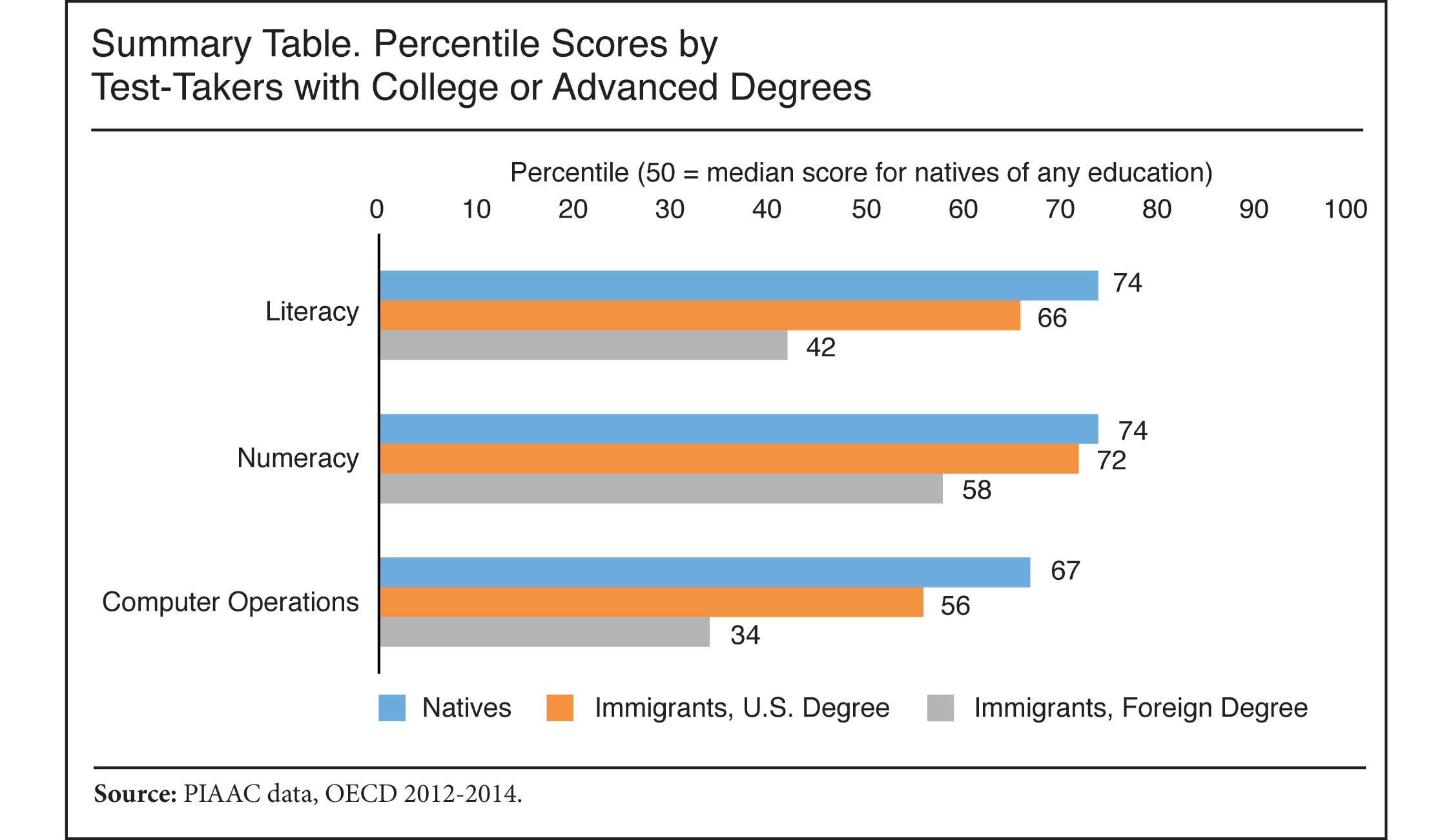 |
Although skilled immigration may be desirable, policy-makers must be cautious in using foreign degrees as proof of those skills. This report has shown that immigrants with foreign degrees perform substantially worse than U.S. degree holders on tests of literacy, numeracy, and computer operations. In some cases, the gaps are so large that immigrants with foreign college degrees have skills that resemble those of natives who have only a high school diploma. Although poor English clearly plays a role in the disparity — and a command of English is essential for success in most high-skill occupations in the United States — the disparity persists even among immigrants who have had at least five years to learn English after arriving.
In Congress, some proposed immigration reforms acknowledge the greater value of U.S. degrees. For example, the RAISE Act would establish a points system for high-skill immigrants that prioritizes U.S. degrees over foreign degrees. It would also go beyond educational credentials by giving extra points for English fluency, STEM specialties, and pre-arranged employment. Ultimately, policy-makers should consider making skill selection even more direct. Universities, the foreign service, and the military have been using standardized testing for decades to evaluate applicants. For example, people who want to do advanced study in important subjects such as biology, chemistry, and physics need to take the Graduate Record Exam (GRE) to demonstrate their knowledge and preparation. Perhaps Congress could integrate similar tests into a truly high-skill immigration system.Please read the whole thing.
For decades, immigration enthusiasts have offered conflicting assurances to skeptics who perceive a lack of assimilation among newcomers. Multiculturalism is a great gift to the United States, so why worry? Also, assimilation is proceeding apace, so, again, why worry? The former assurance is generally directed at liberals, and the latter is directed at conservatives, but the underlying point is the same—nothing to see here, just move along.
Pundits repeated the same assurances last month after Tom Brokaw remarked on how “Hispanics should work harder at assimilation,” and that “they ought not to be just codified in their communities but make sure that all their kids are learning to speak English.” Despite the furor and his subsequent apology, Brokaw is right to be concerned. When it comes to language assimilation, neither of the standard assurances is convincing.Please read the whole thing.